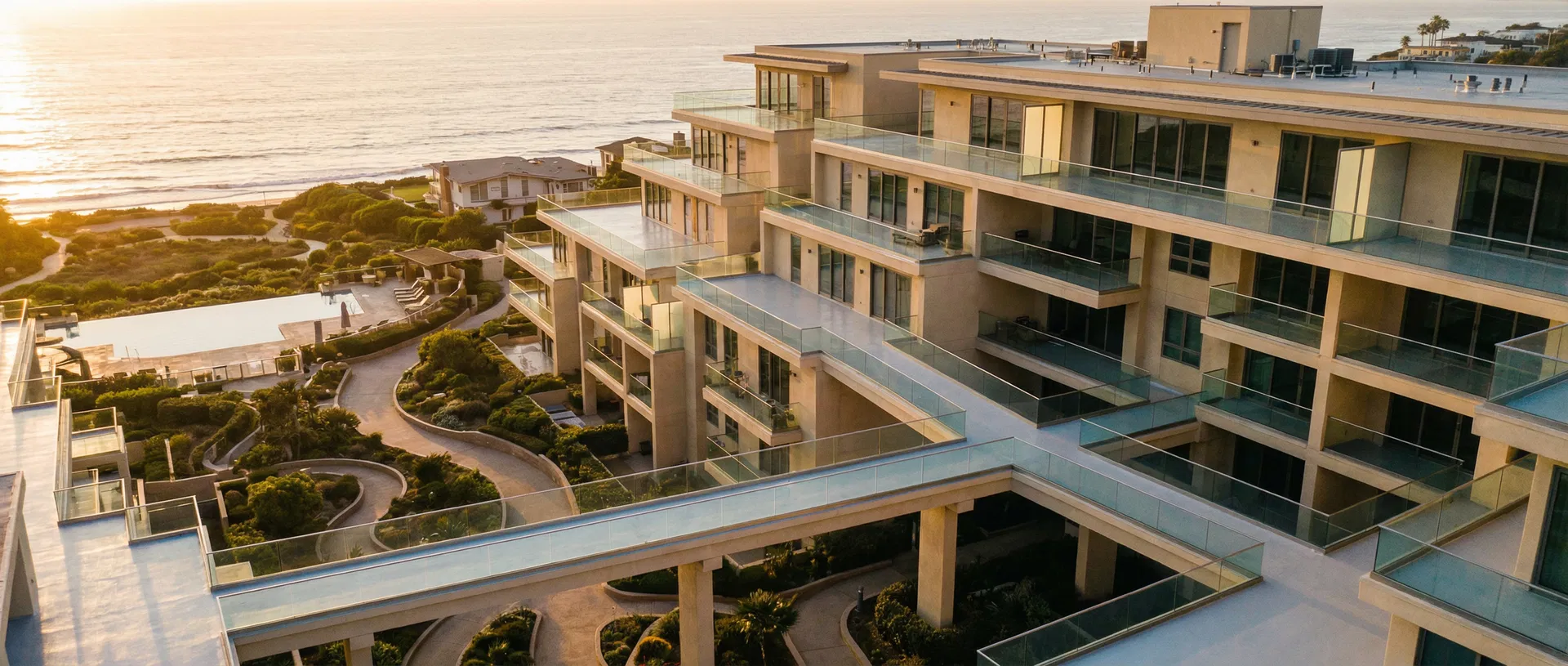
You May Already BeOut of Compliance
California's SB 326 and SB 721 balcony inspection deadlines have both passed. If your property hasn't been inspected, you're accumulating liability and risking fines up to $500 per day. Find out where you stand and how to fix it — fast.
Compliance Checker
Are You Already Out of Compliance?
Both SB 326 and SB 721 deadlines have passed. Answer a few questions to find out if your property is exposed — and what to do about it.
What type of property do you manage?
This determines which law applies to your building.
Free Professional Tools
Tools That Complement Your Existing Workflow
Whether you inspect, repair, or manage properties — we built free tools that plug into what you're already doing. No account required. No strings attached.
Law Comparison
SB 326 vs. SB 721: Side by Side
California has two separate balcony inspection laws that are frequently confused. Understanding which applies to your property is the critical first step toward compliance.
Swipe left to see all columns.
Legislative Timeline
From Tragedy to Law: Key Dates
Understanding the history behind these laws helps explain why compliance is taken so seriously by enforcement agencies and courts.
Berkeley Balcony Collapse
A fourth-floor balcony at the Library Gardens apartment complex in Berkeley collapses, killing 6 and injuring 7. Investigation reveals severe wood decay from water intrusion in 8-year-old laminated veneer lumber joists.
SB 721 Signed Into Law
Governor Jerry Brown signs SB 721, requiring mandatory inspections of exterior elevated elements on multifamily rental buildings with 3+ units. Codified in Health & Safety Code §17973.
SB 326 Signed Into Law
SB 326 is signed, extending similar inspection requirements to condominiums and common interest developments. Codified in Civil Code §5551.
SB 326 Takes Effect
Compliance requirements for condominium associations begin. HOA boards must start planning for mandatory inspections of exterior elevated elements.
AB 2579 — Deadline Extension
Assembly Bill 2579 extends the SB 721 inspection deadline by one year to January 1, 2026. The SB 326 deadline remains unchanged at January 1, 2025.
SB 2114 — Inspector Pool Expanded
Senate Bill 2114 adds licensed civil engineers to the qualified inspector pool for SB 326 inspections, previously limited to structural engineers and architects.
SB 326 Deadline — PASSED
Initial inspection deadline for all condominium associations. Properties without completed inspections now face daily penalties of $100–$500 and potential negligence per se liability.
SB 721 Deadline — PASSED
Initial inspection deadline for all multifamily rental buildings. Non-compliant property owners are now subject to daily fines, safety liens, and increased legal exposure.
Next Inspection Cycles Due
SB 721 properties must complete their second inspection by 2032 (6-year cycle). SB 326 properties must complete their second inspection by 2034 (9-year cycle).
Inspection Guide
What to Expect: The Inspection Process
Both laws require professional inspection of exterior elevated elements (EEEs) — structures more than 6 feet above grade, designed for occupancy, with wood-based support.
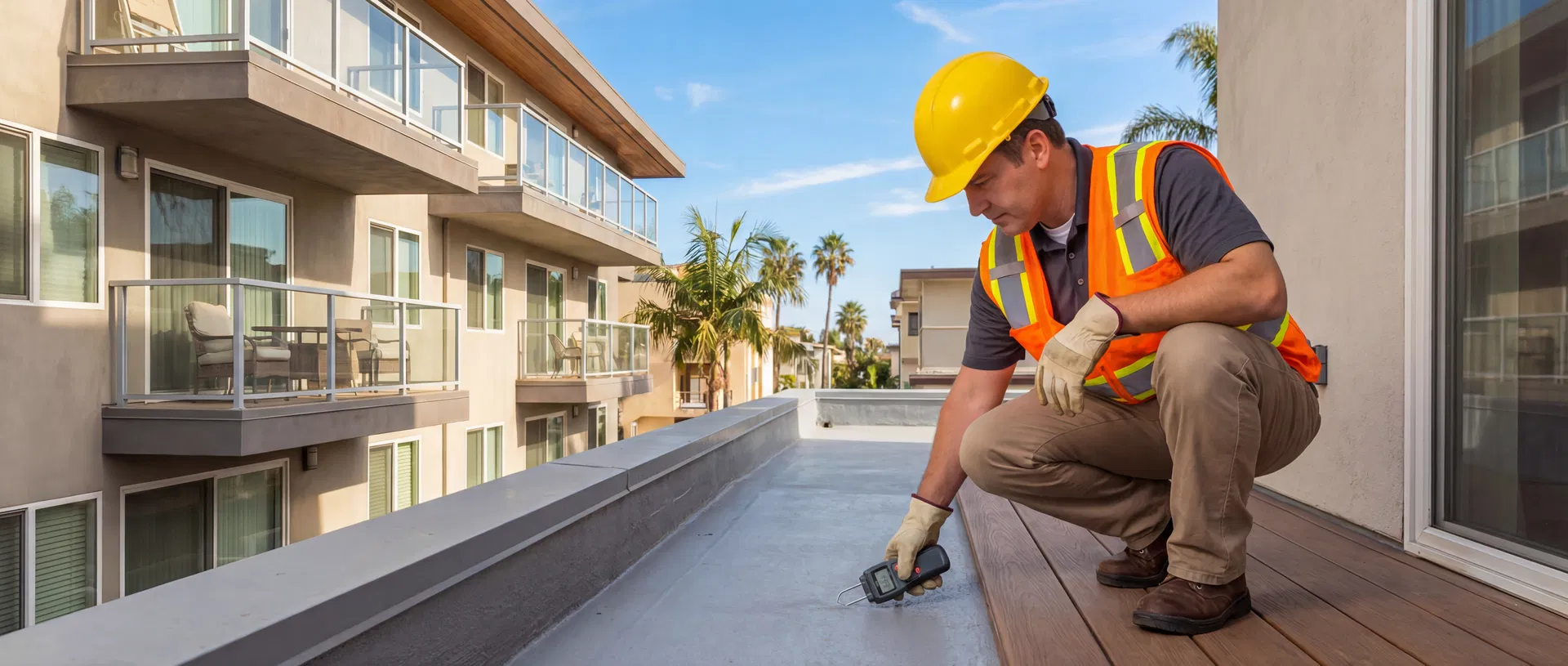
Inspectors evaluate both visible surfaces and concealed structural components using moisture meters, borescopes, and infrared imaging.
Hire a Qualified Inspector
Select a licensed professional based on your property type. For condos (SB 326): structural engineers, architects, or civil engineers. For apartments (SB 721): also includes contractors with A/B/C-5 licenses and 5+ years experience. Verify active California licensure.
Coordinate Access & Schedule
The inspector needs access to individual units if balconies are accessed from inside. Notify tenants and schedule access windows. Both laws authorize landlords/HOAs to enter units for compliance purposes.
Visual Inspection & Sampling
The inspector examines the required sample of exterior elevated elements. SB 721 requires at least 15% of each element type. SB 326 requires a statistically significant sample (95% confidence, 5% margin of error). Inspections typically take 2–8 hours depending on property size.
Exploratory Openings & Testing
If visual inspection reveals suspected concealed damage, the inspector creates exploratory openings — small cuts in surface materials to examine hidden framing. Tools include moisture meters, borescopes, and infrared imaging to detect water intrusion.
Receive the Inspection Report
The inspector delivers a written, stamped, and signed report within 45 days. The report classifies each element as passing, needing non-emergency repairs (NERR), or needing emergency repairs (ERR). This report is your roadmap for compliance.
Take Action Based on Results
Pass: Retain records and prepare for the next cycle. Non-emergency repairs: Apply for permits within 120 days (SB 721). Emergency repairs: Immediate action required — restrict access, notify authorities within 15 days, begin repairs within 15–30 days.
Elements That Must Be Inspected
Both laws cover exterior elevated elements more than 6 feet above grade, designed for human occupancy, with substantial wood support.
- Balconies
- Decks and porches
- Stairways and landings
- Walkways and breezeways
- Entry structures
- Railings and guardrails
- Waterproofing systems (flashings, membranes, coatings, sealants)
- Load-bearing components (joists, beams, ledger boards, connectors, fasteners)
Warning Signs to Watch For
Water intrusion causing wood decay is the primary structural failure mechanism. Monitor for these warning signs between inspection cycles.
Penalty Calculator
Your Fines Are Accruing Right Now
Both SB 326 and SB 721 deadlines have passed. If your property hasn't been inspected, civil penalties of $100 to $500 per day may already be accumulating. Beyond fines, you face negligence per se liability, safety liens, and potential criminal exposure. Use this calculator to see what your delay is costing you.
Fine Estimator
$22,500
90 days at $250/day
$91,250
If non-compliance continues for a full year
Beyond Financial Penalties
Daily fines are often the least significant consequence. The real risks include:
Negligence Per Se
Violating SB 326/721 can establish automatic negligence in personal injury lawsuits. If someone is injured on a non-compliant balcony, the property owner's liability is essentially presumed.
Safety Liens
Local building departments can place liens on properties for unresolved safety violations. These liens attach to the property and must be satisfied before sale or refinancing.
Insurance Impact
Carriers are increasingly requiring proof of SB 326/721 compliance. Non-compliant properties face policy cancellations, coverage exclusions, or dramatically higher premiums.
Board Personal Liability
HOA board members who fail to initiate inspections may face personal liability under their fiduciary duty obligations. The Davis-Stirling Act requires boards to maintain common areas.
Material Compliance
Failed Your Inspection? Here's What to Fix
Water intrusion causing wood decay is the #1 finding in SB 326/721 inspections — and the primary cause of the balcony failures these laws were written to prevent. If your inspection revealed deficiencies, waterproofing is almost certainly part of the repair scope.
Waterproofing Systems
The most critical compliance factor. Both laws require functional waterproofing to protect wood-framed structural elements from moisture intrusion — the primary cause of balcony failure.
- Continuous waterproof membrane or coating over all walking surfaces
- Proper flashing at wall-to-deck connections and penetrations
- Adequate slope for drainage (minimum 2% or ¼" per foot)
- Sealed joints and transitions between dissimilar materials
- UV-resistant finish coat to prevent membrane degradation
Structural Components
Load-bearing elements must be free from decay, corrosion, and damage. Inspectors evaluate the structural integrity of all wood framing and connections.
- Joists, beams, and ledger boards free from decay and damage
- Proper metal connectors and fasteners (galvanized or stainless steel)
- Adequate bearing and connection to the building structure
- No evidence of insect damage (termites, carpenter ants)
- Proper preservative treatment for exposed wood members
Railings & Guardrails
Guardrails must meet current building code requirements for height, spacing, and load capacity. These are life-safety elements that prevent falls.
- Minimum 42" height for guardrails (California Building Code)
- Maximum 4" spacing between balusters
- 200 lbs concentrated load capacity at top rail
- Secure attachment to structural framing (not just surface-mounted)
- No evidence of corrosion, decay, or loosening at connections
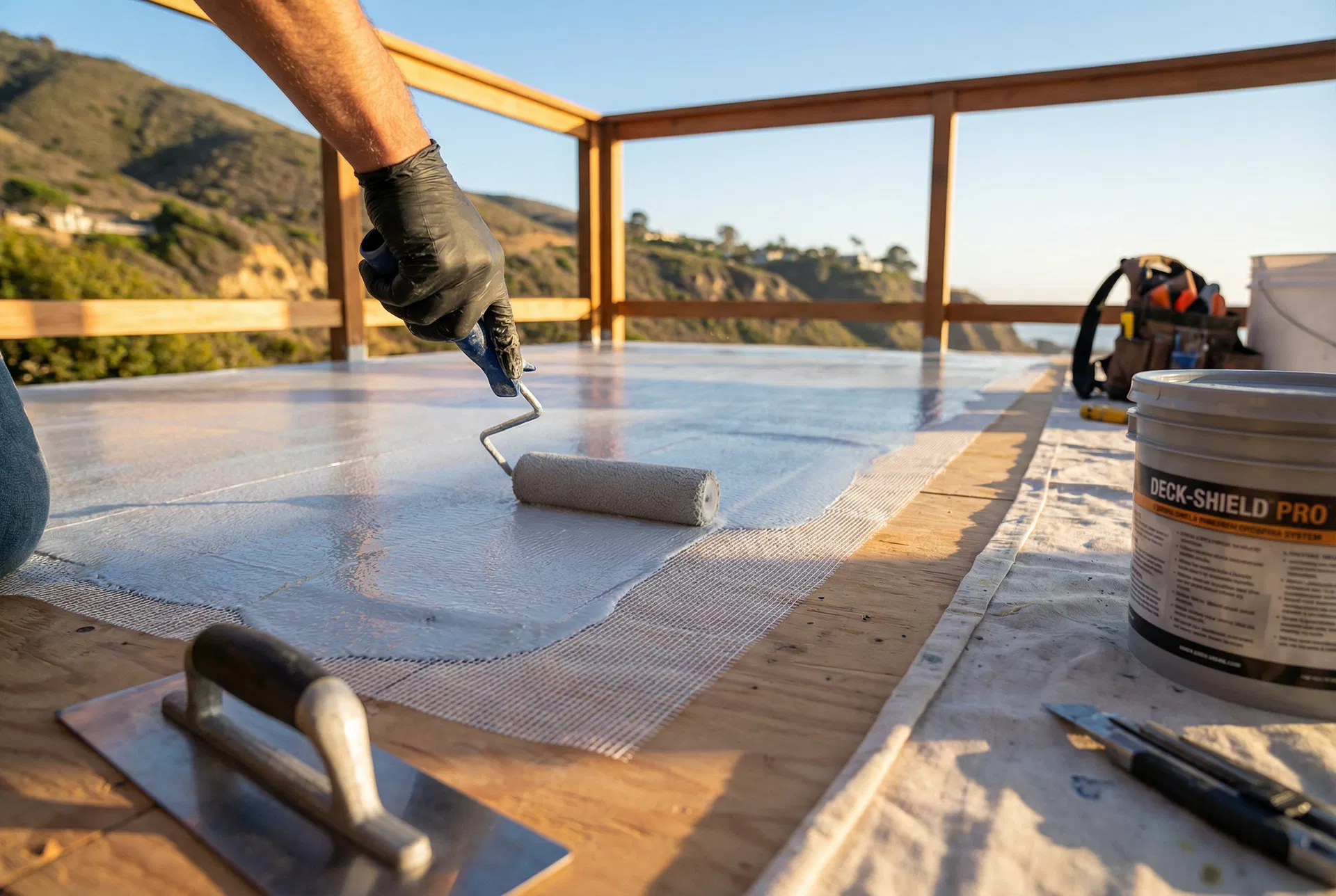
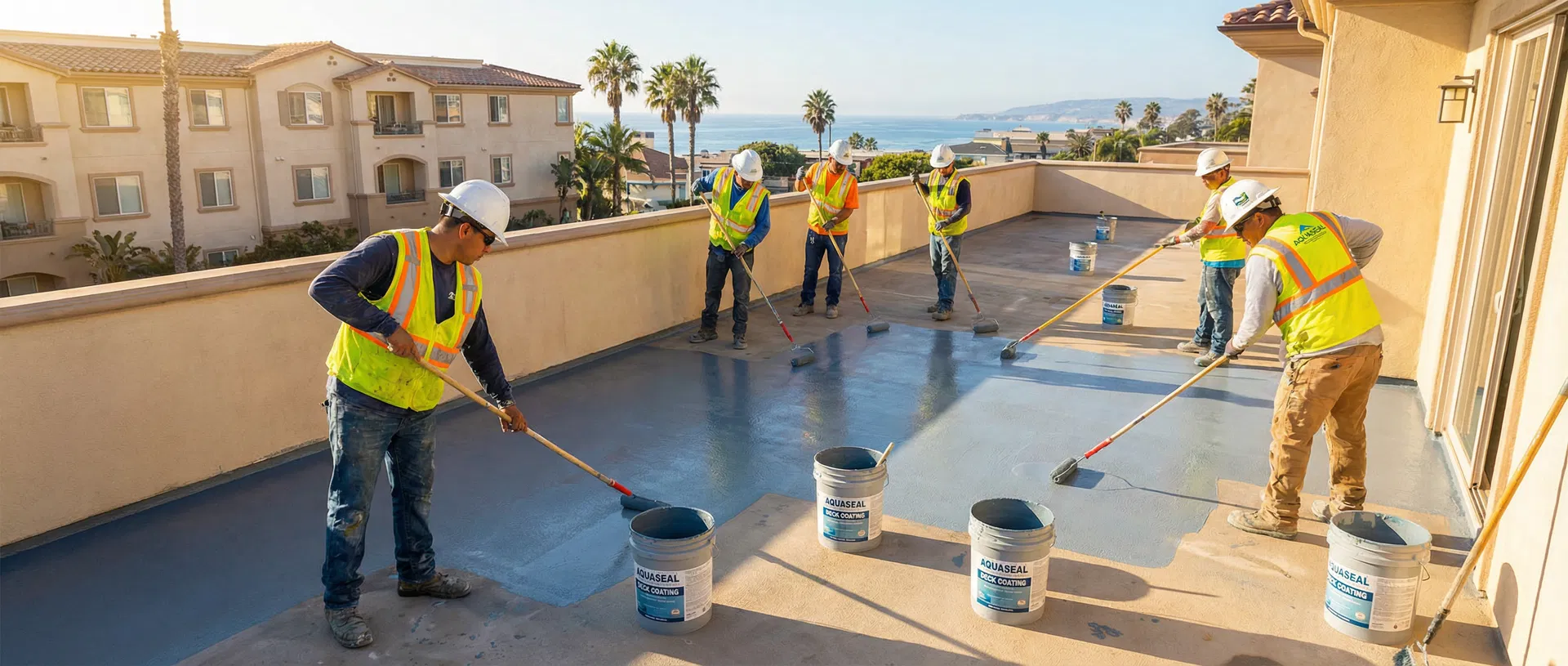
A fiberglass-reinforced waterproofing system being applied to a plywood deck substrate.
The #1 Reason Properties Fail Inspection
Both SB 326 and SB 721 were enacted specifically because of waterproofing failures. A functional waterproofing system is the single most important factor in preventing the type of concealed wood decay that leads to structural failure.
Inspectors evaluate waterproofing systems for continuity, adhesion, slope, drainage, and condition. Failed or deteriorated waterproofing is the most common finding that triggers repair requirements.
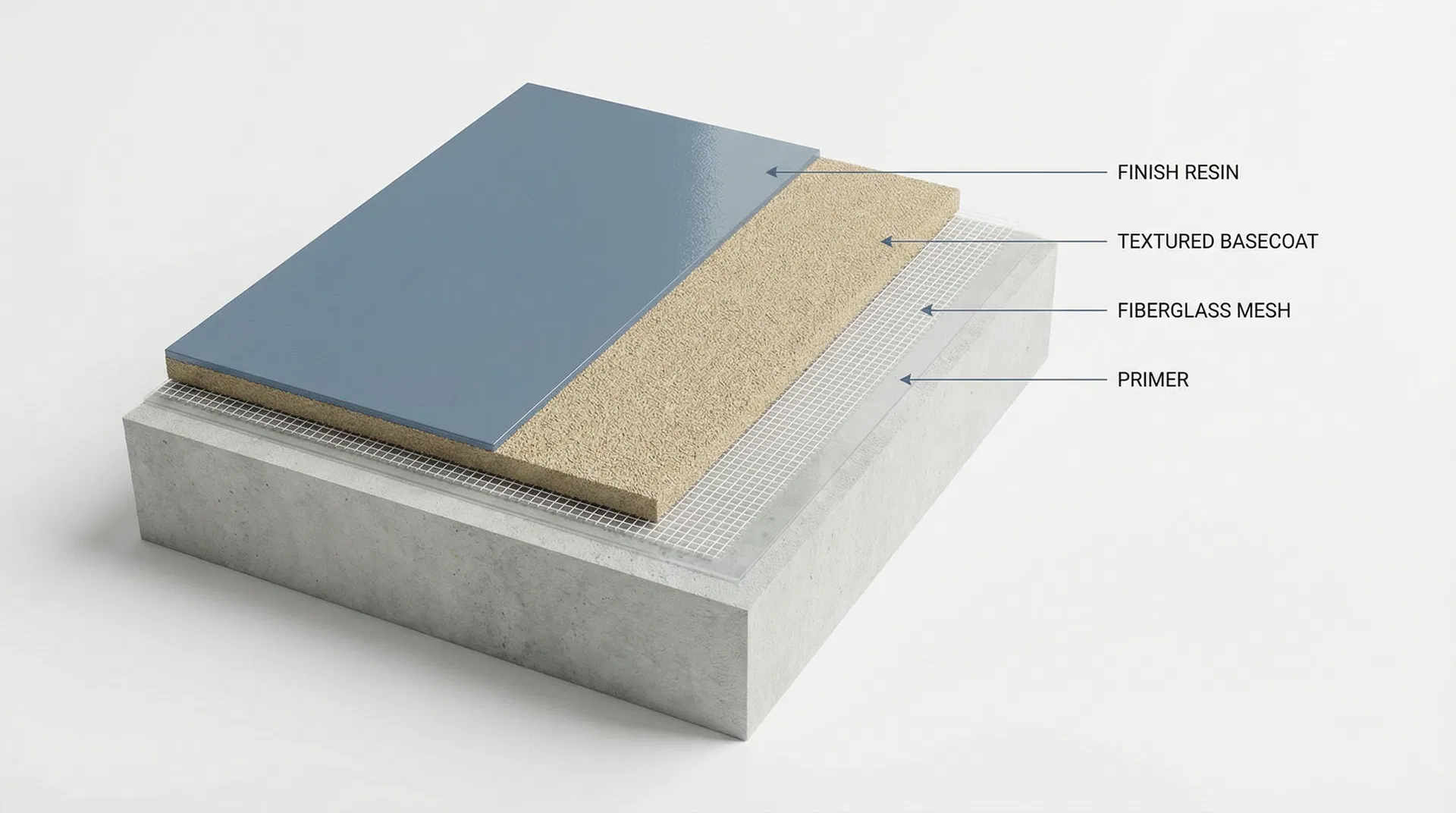
When repairs are needed, the waterproofing system must be fully replaced — not just patched. The replacement system should be fiberglass-reinforced for durability, applied in multiple layers, and include proper flashing integration at all transitions.
Trusted by Iconic Properties
AllDeck waterproofing systems protect some of the most recognized properties in the world.
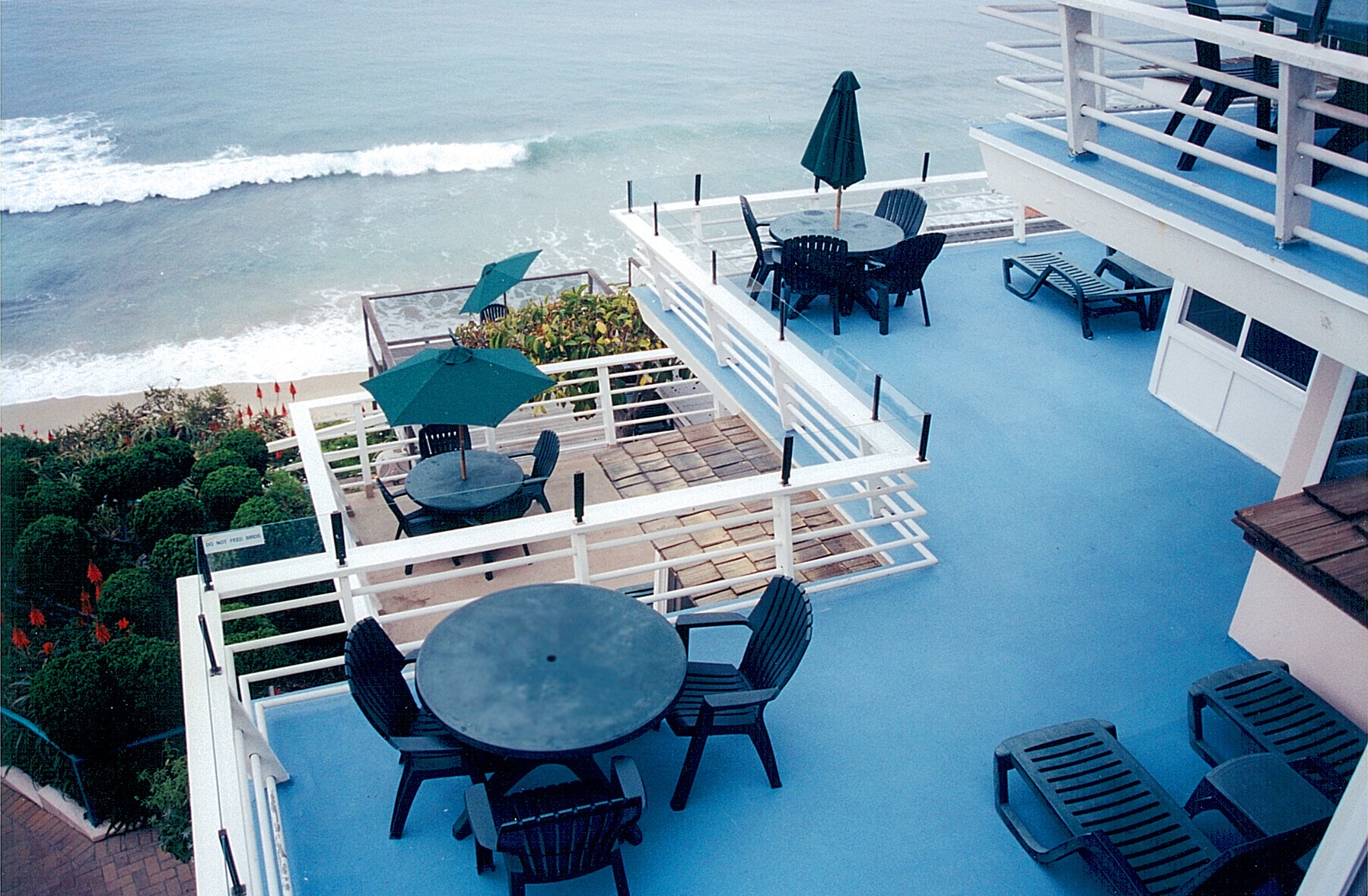
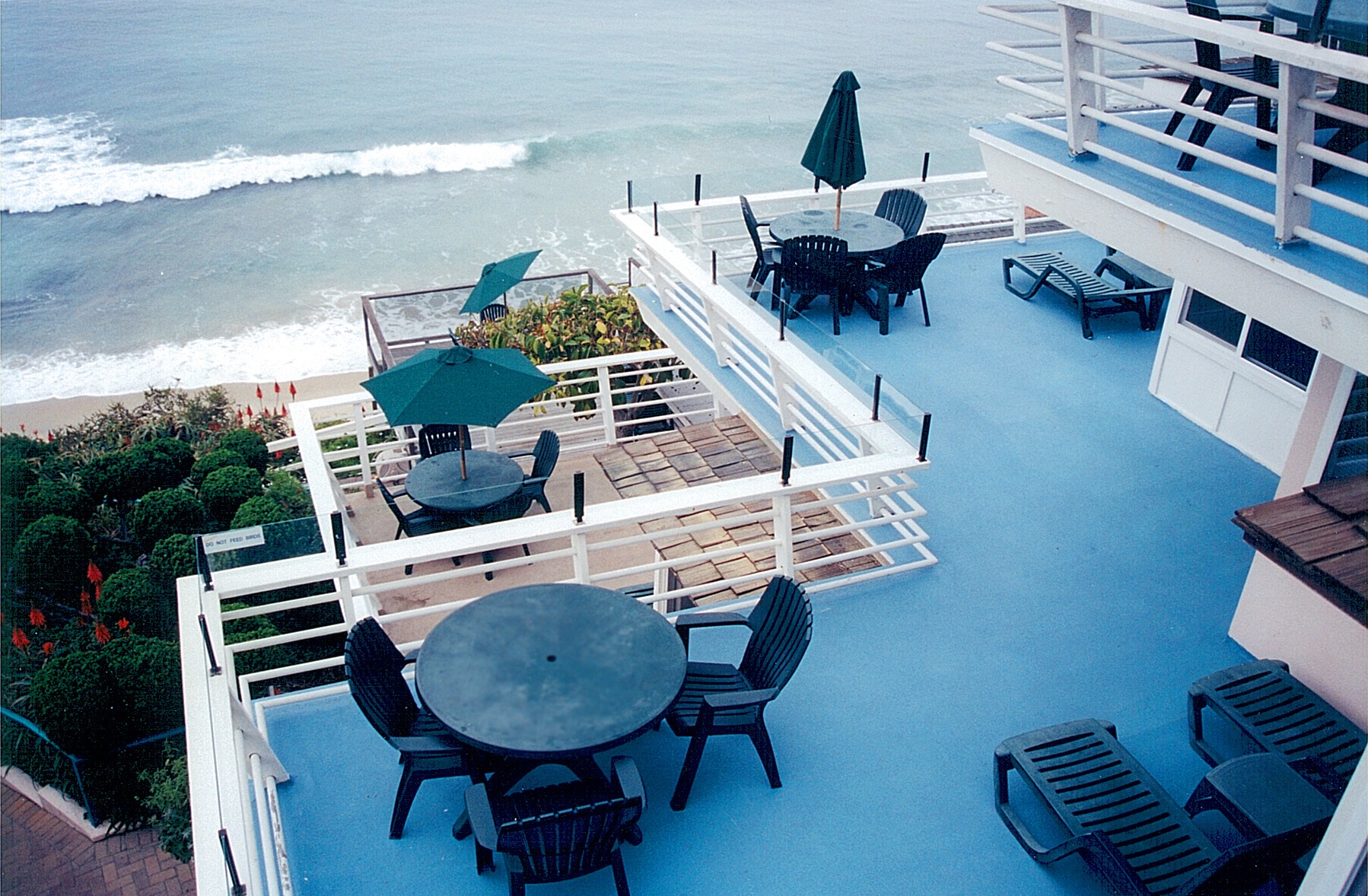
Laguna Royale Hotel
Laguna Beach, CA
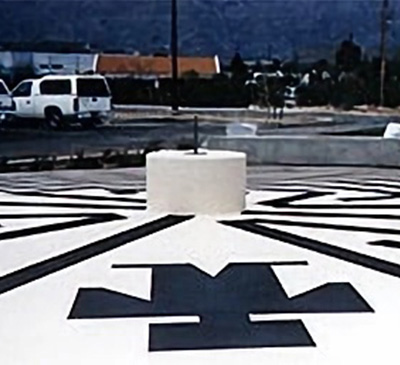
Disneyland Teacup Ride
Anaheim, CA
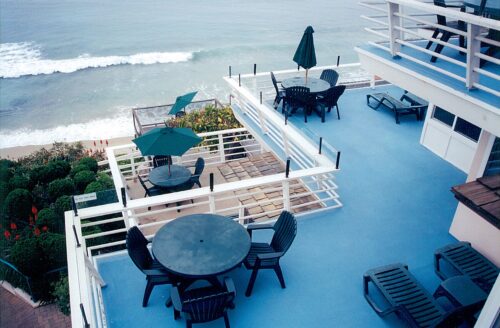
Pier 39
San Francisco, CA
Universal CityWalk
Universal City, CA
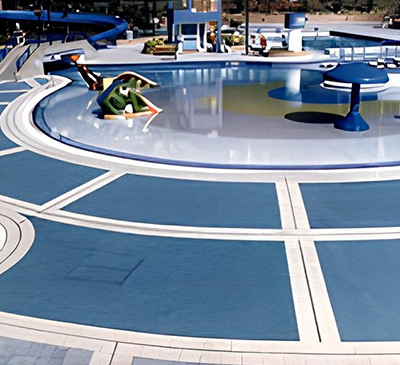
Rooftop Deck System
Southern California
Rooftop Pool Deck
Hawaii
Get Back Into Compliance — Fast
Waterproofing systems proven to resolve the most common SB 326/721 inspection failures.
AllDeck Waterproof Coating System
Fiberglass-reinforced, water-based acrylic waterproofing system that creates a seamless, monolithic membrane over balcony and deck surfaces.
AllDeck Concrete Repair & Patching
Structural repair compounds for addressing spalling, cracking, and deterioration in concrete balcony elements before waterproofing.
AllDeck Prime & Seal
Bio-control primer that seals substrates and prevents mold/mildew growth — addressing the root cause of wood decay that triggers SB 326/721 violations.
ALL DECK by FSC Coatings has been providing fiberglass-reinforced waterproofing systems since 1975. Their products are building and health department approved, fire-resistant, ADA compliant, and backed by a 10-year limited material warranty. View products →
Compliance Checklists
Download printable checklists to bring to your HOA board meeting, share with your property manager, or use as a field reference during inspections. AllDeck branded with compliance product recommendations.
SB 326 Checklist
Complete compliance checklist for condominium associations under Civil Code §5551.
SB 721 Checklist
Complete compliance checklist for apartment buildings under H&S Code §17973.
Quick Reference Guide
Side-by-side comparison and immediate action steps for both SB 326 and SB 721.
Truhub-Compatible Architecture
The AllDeck Ecosystem
Behind these free tools is a connected platform designed to serve the entire compliance lifecycle — from inspection through completed repair. Four integration modules are built and ready for configuration.
Subdomain Architecture
compliance.alldeck.com
SB 326/721 compliance tools, free resources for inspectors, contractors, and property managers
marketing.alldeck.com
Content, campaigns, and analytics for the AllDeck brand
store.alldeck.com
Product catalog, ordering, and account management
command.alldeck.com
Owner dashboard — operations, compliance, employees, financials
WooCommerce
Module ReadyProduct catalog, order management, and customer accounts. Contractors can browse and order materials directly through the AllDeck online store.
Decor Fusion / WorldPay
Module ReadyDecor Fusion by Epicor POS integration with WorldPay merchant services. Inventory tracking, transaction records, and payment processing for in-person and phone orders.
Twilio SMS
Module ReadyNotifications for new inquiries, scheduling confirmations, and follow-up reminders. Two-way texting so conversations happen where people already communicate.
Gmail
Module ReadyWelcome emails for new contacts, documentation delivery, and summary digests. OAuth2 and SMTP modes supported for reliable delivery.
Data Flow
Shared Database
All subdomains share the same database using the Truhub module pattern. Contacts, integration configs, and notification logs are accessible across compliance, marketing, store, and command subdomains.
Security & Compliance
Encrypted API connections, OAuth 2.0 authentication, and PCI-DSS compliant payment processing. Property data and inspection records are never shared without explicit authorization.
Frequently Asked Questions
What You Need to Know Right Now
Both deadlines have passed. Here are the answers to the questions property owners, managers, and HOA boards are asking most urgently.